



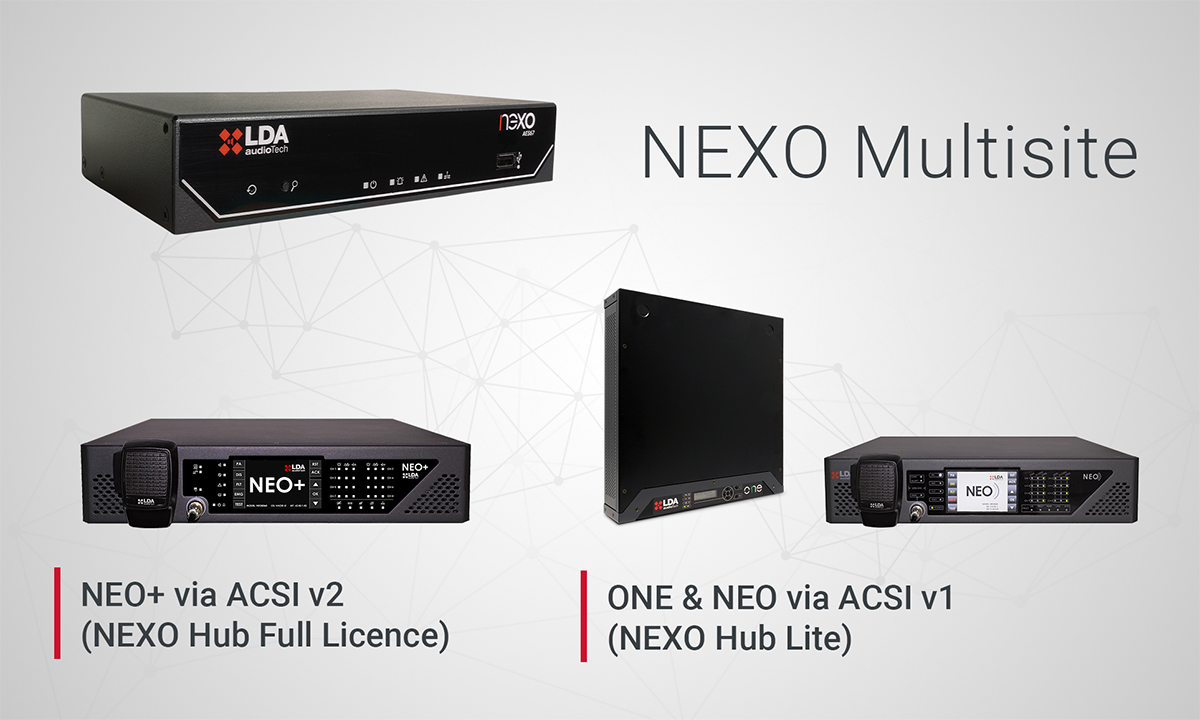
23 Jul How NEXO integrates ONE, NEO and NEO+ systems in multisite installations
The LDA NEXO converter allows ONE, NEO and NEO+ systems to be integrated into multisite architectures where several independent installations need to be coordinated from a higher level of control. This integration helps combine two common requirements in audio for safety projects: maintaining the operational autonomy of each local system and enabling centralised management when the venue, complex or infrastructure requires it.
In ONE and NEO systems, this integration is carried out through NEXO Hub Lite, a standard feature included in NEXO and designed for installations based on the ACSIv1 bus. In NEO+ systems, the recommended option is to use a NEXO Hub licence, which enables native integration through ACSINet and provides greater capacity for concurrency, supervision and status information.
The challenge of a multisite architecture
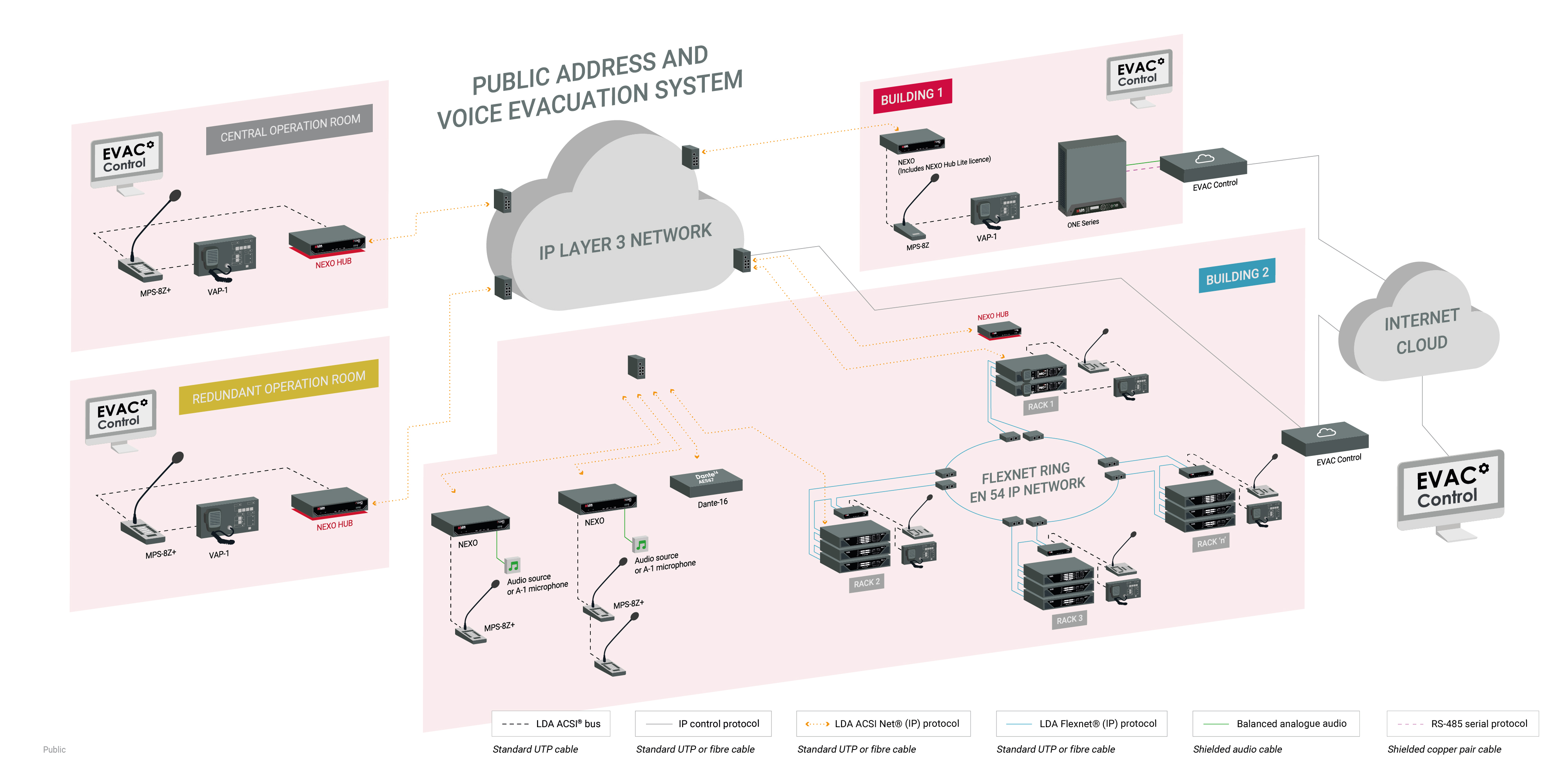
Several public address and voice alarm systems can coexist in a multisite installation. Each one serves a specific zone, building, unit or operational area, while still forming part of the same environment.
The challenge is to coordinate these systems while preserving the local logic of each installation. A system may need its own announcements, background music, internal messages or local evacuation. At the same time, the operator of the overall site may need a control point from which to act on several areas, launch general announcements or supervise status information.
This type of architecture appears in shopping centres, campuses, hospitals, airports, corporate buildings, hotels, resorts and industrial complexes.
A clear example in shopping centres
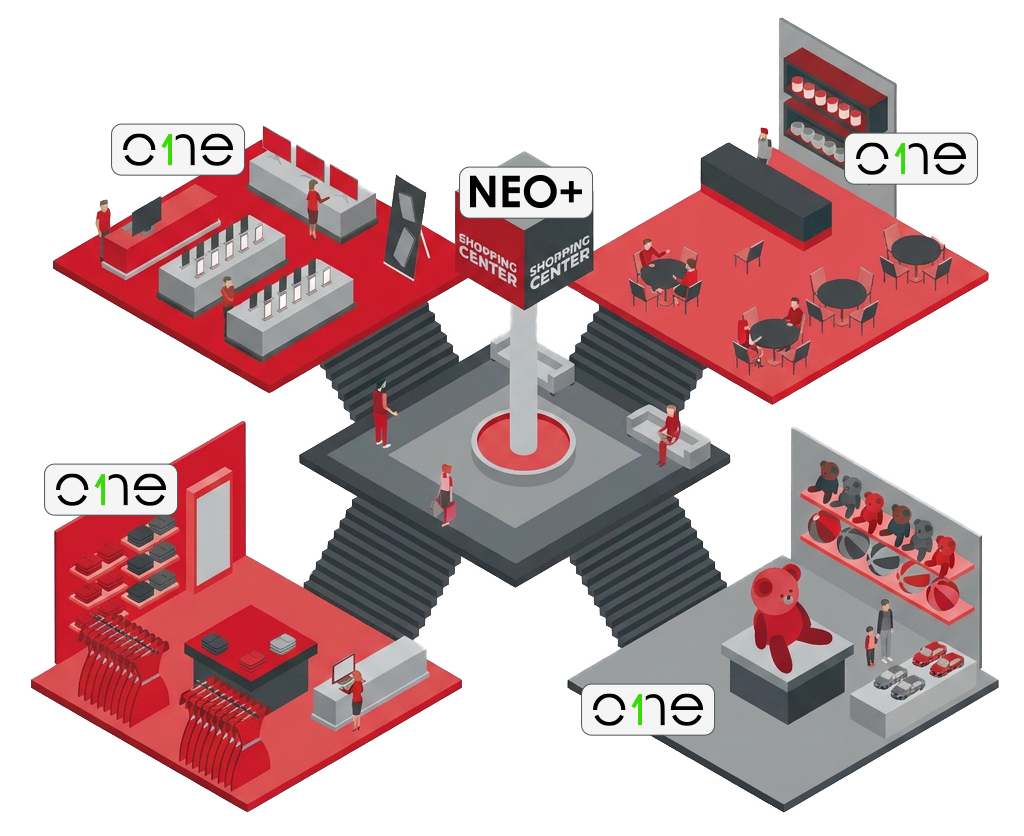
A typical use case is a shopping centre. Each shop can have its own ONE system to manage local announcements, background music, internal messages, local evacuation and connection to its fire alarm control panel. Common areas, such as corridors, car parks, entrances or technical areas, may require a NEO+ system with greater integration and operation capacity.
The installation needs each part to operate on its own, while also allowing the whole system to be coordinated from a control point. NEXO connects these system islands within a multisite architecture, adapting the integration mode depending on whether the local system is ONE or NEO+.
How ONE and NEO are integrated through NEXO Hub Lite
ONE is a compact solution for installations that need public address and voice alarm with local operation. Thanks to NEXO, it can now be integrated into a multisite architecture and used in independent spaces where a dedicated local installation is required, while still being connected to the wider system.
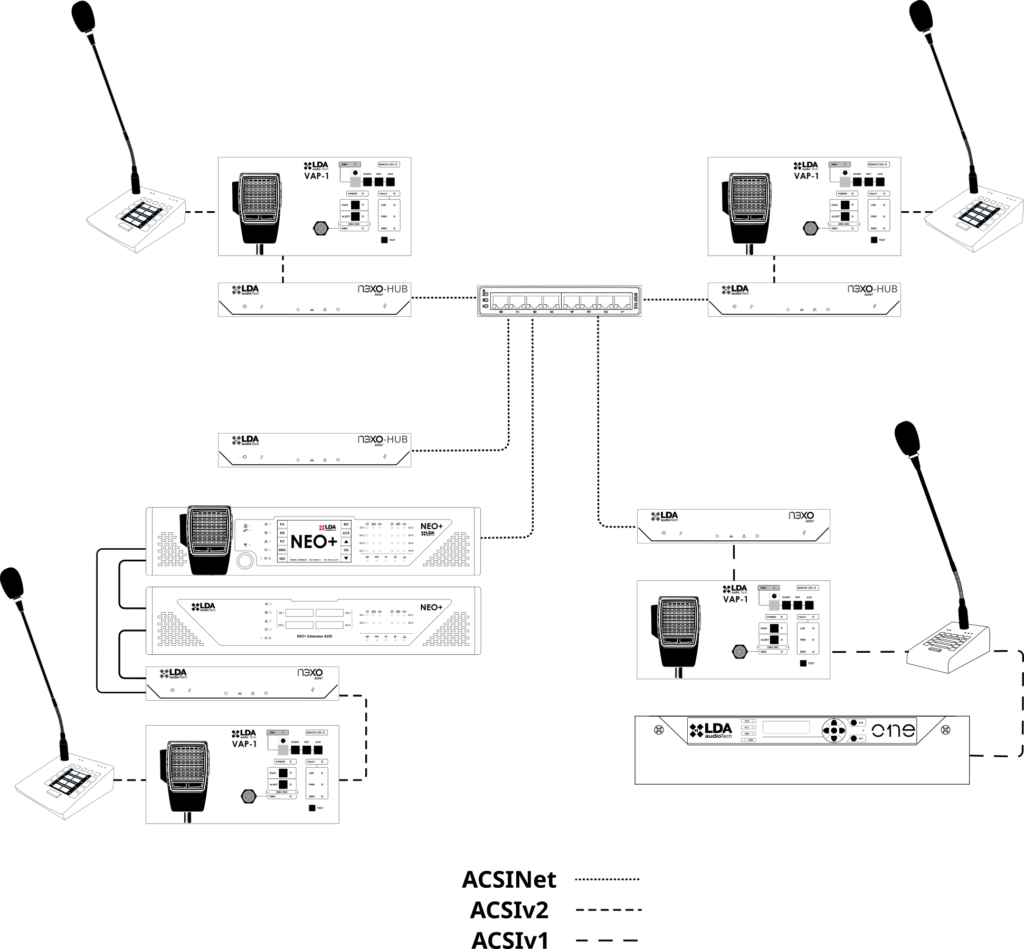
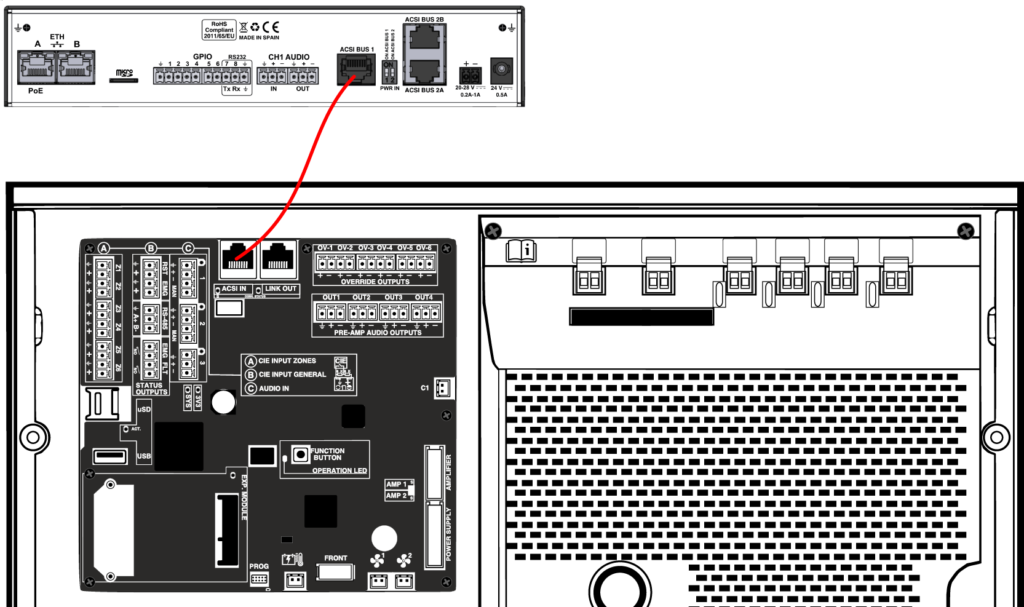
According to the NEXO manual, ONE and NEO systems based on ACSIv1 can be integrated through NEXO Hub Lite. This feature is included as standard, with no additional licence, and allows NEXO to be used as the cluster receiver in Gateway to ACSIv1 Site mode.
In practice, NEXO acts as a gateway between the central level of the architecture and the local ONE system. ONE identifies NEXO as two virtual ACSIv1 devices:
- an MPS-8Z microphone for general public address calls;
- a VAP-1 voice alarm panel for emergency calls and actions.
This allows ONE to retain its local operation and receive requests from the higher level of control when the project requires it.
Scope of the ONE integration
Integrating ONE through NEXO Hub Lite allows ACSIv1-based systems to be connected to a multisite architecture while maintaining a clear relationship between the local system and the central control point.
Voice requests from microphones connected to the cluster can be transmitted from the central control point. Available ACSIv1 microphone functions can also be sent, including VAP-1 fire panel functions for emergency calls.
From the ONE system to the central level, the general EMG and FLT statuses are distributed. The link between NEXO and the ONE system is also supervised through the ACSIv1 bus.
There are limits to this integration mode: specific information about zones or groups is not transmitted, VAP1-FES cannot be used, button assignment to zones or groups cannot be customised, and triggers or events cannot be launched.
Why we recommend the full NEXO Hub licence for NEO+
NEO+ is designed for medium and large projects with greater integration, scalability and operational requirements. In a multisite architecture, it can cover common areas, main buildings or areas where greater control capacity is required.
When the remote system is NEO+, the recommended option is to use the full NEXO Hub licence in Gateway to Domain ACSINet mode. In this case, NEO+ works natively within ACSINet, making better use of the system’s capabilities.
This approach provides greater simultaneous operation:
- up to 16 simultaneous microphone calls, one to each connected Domain;
- up to 56 simultaneous BGM audio channels.
It also distributes EMG, FLT and DIS statuses, while ACSIv1-based integration works with EMG and FLT. Link supervision and fault notification to the NEO+ system are also included.
How to configure calls to a full domain or by zones
The NEXO Hub device acting as Cluster-Sender is set to one of these two modes:
- “Map button to domain/site”: each microphone button places a call to a complete island. Every system receives an “all-zones” call (if its button has been selected). The ID of the system that each button calls matches the Cluster-Receiver-ID configured on the NEXO Hub controlling it.
- “Map button to ACSI profile”: in this mode, the user’s button press is carried through to each of the sites/systems, where it’s translated into the zones/groups configured according to the profile assigned to that ACSI microphone address, bearing in mind that:
- NEO+ profile configuration is customisable. Each NEO+ system has its own microphone profile configuration table. By default, the assignment is button_1 → zone_1, and so on. It’s worth remembering that these microphone profiles apply both to ACSI microphones on the NEO-8060+ local bus and to those received via ACSINet, whether from a cluster or a domain.
- For ONE, the logic is the same, but with the limitation that ONE doesn’t allow configuration of ACSI microphone profiles. Here, the button-zone assignment is always the factory default: Btn_1 → Zone_1, Btn_2 → Zone_2, and so on.
To put this into practice, picture a multi-site setup where each system is a building. “Button to domain” mode lets you call entire buildings, while “button to profile” mode lets you call by floor (provided the profiles are configured correctly). Button 1 could be floor 1 of each building, button 2 could be floor 2, and so on.
An architecture designed for distributed projects
Many installations grow by buildings, zones, units, phases or extensions. This makes it useful to have an architecture capable of integrating compact systems such as ONE and scalable systems such as NEO+ under a common operational criterion.
NEXO helps build that bridge between local autonomy and centralised management. For LDA, this approach forms part of a broader vision of audio for safety: designing public address and voice alarm systems that respond to the real use of the building, its operational needs and the future evolution of the project.
Are you designing a multisite audio for safety architecture?
Contact the LDA team to review which integration mode best fits your ONE, NEO+ and operational requirements.
FAQ: multisite system integration with LDA NEXO
What does NEXO bring to a multisite installation?
NEXO connects different system islands within a distributed architecture, helping coordinate local systems and control points.
How are ONE and NEO integrated into a multisite architecture?
ONE and NEO are integrated through NEXO Hub Lite, a standard feature that connects ACSIv1-based systems to the higher level of the architecture.
When should a NEXO Hub licence be used?
A NEXO Hub licence is recommended when the remote system is NEO+ and the project requires native ACSINet integration, greater simultaneous operation, more supervision and more status information.
Can ONE, NEO and NEO+ coexist in the same multisite project?
Yes. ONE can be used in local islands, such as shops or independent spaces, while NEO+ can cover common areas, main buildings or areas of greater complexity.
What example helps explain this architecture?
A shopping centre is a clear case: each shop can keep its own ONE system, while common areas can be managed with NEO+ and coordinated from a central control point through NEXO.
Should the NEXO Hub always be installed outside the FlexNet ring?
Yes. The NEXO Hub must always be installed outside the FlexNet ring.
It can be connected in the following ways:
- To port X of the NEO+ controller, when the island has a single controller.
- To a switch on the multi-domain or cluster network, when a common network infrastructure exists between the different islands.
The connection must be made upstream of the controller’s port X, as the NEO+ filters traffic leaving its FlexNet network towards the external network. This prevents an island’s internal communications from propagating and interfering with the others, particularly given that all islands use the same Stream by default.
The NEXO Hub must not be connected to the port X of an extension, nor integrated within the FlexNet ring, as no such filtering exists at those points and conflicts between islands could occur.
Practical summary:
- Standard NEXO for a single domain: can be connected to port X of any device in the domain, or even installed within the FlexNet ring itself.
- NEXO Hub Receiver for a single domain: must always be installed outside the FlexNet ring, connected to port X of the NEO+ controller or to a switch on the multi-domain/cluster network.