



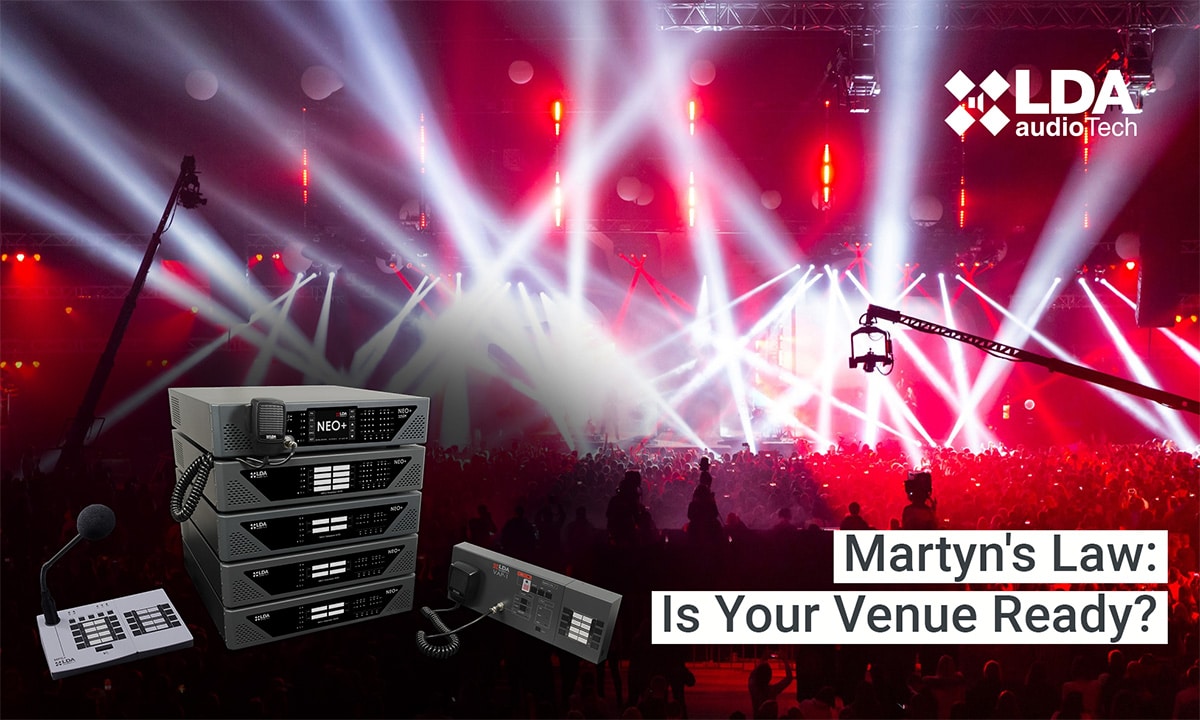
10 Mar Do You Need PA/VA to Comply with Martyn’s Law?
Understanding the Role of Voice Alarm in the Terrorism (Protection of Premises) Act 2025
The Terrorism (Protection of Premises) Act 2025, popularly known as Martyn’s Law, received Royal Assent on 3 April 2025, marking a turning point in public safety in the United Kingdom. With a 24-month implementation period, the legislation imposes new responsibilities on venues and events to reduce the risk of physical harm caused by acts of terrorism.
This article is intended for industry professionals (installers, integrators, and engineers) who advise their customers on how to prepare their installations. In response to the question, ‘Is my current audio system sufficient to meet the new legal requirements in the United Kingdom?’, we’ll try to shed some light on this issue.
Compliance categories: Standard Duty and Enhanced Duty
The law establishes two levels of obligations based on reasonably expected capacity:
- Standard Duty Premises (200–799 people): premises where between 200 and 799 individuals are expected to be present at the same time. The responsible person must ensure, as far as reasonably practicable, that adequate public protection procedures are in place (Section 5), with plans for evacuation, evacuation and providing information to people.
- Enhanced Duty Premises and Qualifying Events (800+ persons): premises or events with a capacity of 800 persons or more. In addition to the above procedures, these must implement public protection measures (Section 6) to reduce their vulnerability to attack, including monitoring and systems to minimise the risk of physical harm.
Public protection obligations
The law explicitly defines what ‘public protection procedures’ must cover (Section 5):
- Evacuation: removing people from the premises.
- In-evacuation: moving people to lower-risk locations within the premises.
- Access control: preventing people from entering or leaving the premises.
- Provision of information: communicating instructions to individuals present.
This is where conventional public address systems or fire sirens have critical shortcomings. A siren is a binary signal that often triggers an instinctive evacuation, and this can be counterproductive in a terrorist attack if it leads people towards danger outside. The law requires procedures to provide clear information to enable a coordinated response.
Current security guidelines from the NPSA (National Protective Security Authority) and NaCTSO (National Counter Terrorism Security Office) in the UK are explicit: standard fire alarms may not be adequate for initiating a perimeter lockdown or responding to security incidents.
The EN 54 standard as proof of due diligence
The law is technologically neutral and does not prescribe specific equipment, but rather results. However, it does require that measures be ‘reasonably practicable’.
EN 54 certification is the most widely recognised technical standard for demonstrating that a system meets the requirements of reliability, intelligibility and operational availability implied by the law.
In practice, this translates into:
- Intelligible voice messages (STI): understandable above ambient noise, even in high-pressure situations.
- Priority management: the system automatically overrides any secondary broadcasts (music, announcements) to activate the emergency protocol.
- Zoning: different messages for different areas. This is the difference between evacuating everyone to an exit and managing a coordinated response.
- Line monitoring and integrity: continuous monitoring of the entire system, from the microphone to the last loudspeaker. If something fails, the system detects it before it needs to be used.
- Power backup: emergency batteries that guarantee operation even in the event of a power failure.
- Simple operating interfaces: venue staff must be able to activate protocols without specialised training. Simplicity under pressure is not a detail, it is a requirement.
LDA Audio Tech solutions for Martyn’s Law projects
At LDA Audio Tech, we have two product lines designed to cover the full spectrum of installations affected by the law:
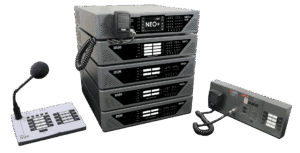
NEO+ — For large venues Enhanced Duty
Designed for complex installations with capacities of 800 or more people: stadiums, convention centres, airports, large shopping centres. NEO+ offers centralised management, advanced zoning, system redundancy and scalability for highly demanding projects. It is the benchmark solution for complying with Enhanced Duty obligations.
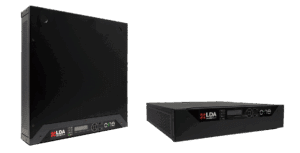
ONE — For Standard Duty facilities and multi-site projects
A compact, cost-effective and easy-to-manage system, ideal for venues in the Standard Duty range (200–799 people) or for integrators managing facilities spread across multiple locations. ONE combines EN 54 certification with a solution that does not exceed the project budget.
Consequences of non-compliance
The UK Security Industry Authority (SIA) will monitor and may issue compliance notices and restriction notices. Breaches may result in significant financial penalties:
- Up to £10,000 for Standard Duty premises.
- Up to £18 million or 5% of global revenue for Enhanced Duty premises, depending on the circumstances set out in the law.
Are you visiting The Fire Safety Event in Birmingham?

Come and see us at stand 4/E57. We’ll show you how to upgrade your facilities to comply with Martyn’s Law using innovative technology based on the EN 54 standard.
Glossary of key terms
- Enhanced Duty: obligations for gatherings of 800+ people.
- Evacuation: procedure for moving to a safe place within the premises.
- NaCTSO: National Counter Terrorism Security Office.
- NPSA: National Protective Security Authority.
- PA/VA: Public Address and Voice Alarm.
- Responsible person: the person in control of the premises or event.
- Standard Duty: obligations for venues with a capacity of 200 to 799 people.
- STI (Speech Transmission Index): parameter for measuring how intelligible a voice message is through a system.
- Terrorism (Protection of Premises) Act 2025: official name of the British law (known as Martyn’s Law) that requires those responsible for certain premises and events to take proportionate measures to reduce the risk of physical harm from acts of terrorism.
Talk to our team
If you are working on a project for the British market or want to prepare a solid technical proposal for a client who must comply with Martyn’s Law, we can help you.
Our team can advise you on which solution (NEO+ or ONE) is best suited to each type of installation, and how to argue the proposal in terms of due diligence and return on risk for the project developer.
Note: This article is for informational purposes only and does not constitute legal advice. For specific guidance on regulatory compliance, we recommend consulting the applicable legislation and, where appropriate, a security specialist or legal advisor with experience in the Terrorism (Protection of Premises) Act 2025.
FAQ: Martyn’s Law and public address and voice alarm systems (PA/VA)
What is Martyn’s Law?
Martyn’s Law, officially the Terrorism (Protection of Premises) Act 2025, is a UK law designed to strengthen the security of premises and events against acts of terrorism. It received Royal Assent on 3 April 2025 and established a 24-month implementation period during which it is not mandatory. It is commonly known as Martyn’s Law in memory of Martyn Hett, a victim of the Manchester Arena attack in 2017.
Does Martyn’s Law explicitly require EN 54 certified equipment?
The law is technologically neutral and focuses on results (reducing the risk of physical harm). However, when it comes to achieving ‘reliable and intelligible emergency communication’ and ensuring that staff can operate the system without fail, EN 54 is a widely recognised technical standard for demonstrating due diligence.
Can I use my existing fire alarm for Martyn's Law safety alerts?
This is not recommended. The use of a fire siren can cause people to instinctively flee towards danger. UK safety authorities (NPSA/NaCTSO) recommend the use of clear voice instructions to differentiate between a fire and a terrorist incident, allowing for a much more accurate response.
What is ‘invacuation’ in the context of the Martyn’s Law?
The law defines invacuation (referred to in Section 5 as ‘moving individuals to a place […] where there is less risk of physical harm’) as the procedure of moving people to a safe area within the premises themselves rather than evacuating them outside.
Who is the ‘person responsible’ for compliance in Martyn’s Law?
According to Section 4 of the law, it is the person who has control of the premises in connection with its specified use (e.g., the operator of a hotel or stadium). This person must ensure that the measures are effective and that staff are prepared to activate them. An intuitive system drastically reduces the risk of human error at critical moments.